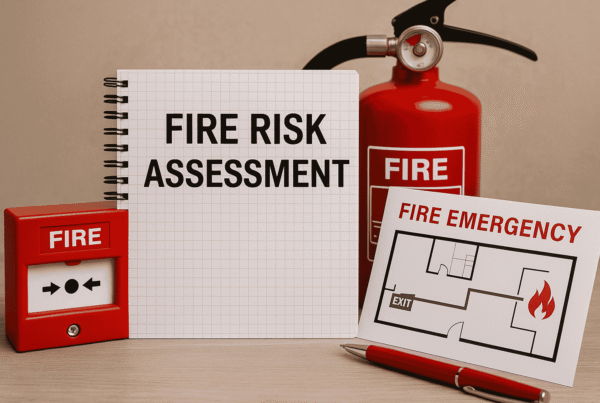


Fire safety regulations for landlords in the UK extend beyond mere compliance; they’re a vital measure to safeguard tenants and protect property investments. With significant legislative developments taking effect through 2026, understanding when and how to update your Fire Risk Assessment (FRA) has become imperative.
Why Landlords Must Maintain an Updated FRA
Under the Regulatory Reform (Fire Safety) Order 2005, landlords, as “Responsible Persons”, are legally obliged to conduct, record and update FRAs for communal and shared areas in multi-occupancy buildings. The Fire Safety Act 2021 expanded this duty explicitly to include external walls, flat entrance doors, and structural components. Furthermore, the Fire Safety (England) Regulations 2022 reinforce obligations pertaining to fire doors, evacuation procedures, and providing updated information to fire authorities.
By ensuring FRAs are current, landlords:
- Protect tenants, including those who are vulnerable, against fire risk;
- Comply with regulatory standards to avoid enforcement actions from the Fire & Rescue Service;
- Maintain valid insurance coverage;
- Demonstrate professional stewardship of their properties.
When Should a Fire Risk Assessment be Updated?
While the law does not specify exact timelines, accepted best practice for landlords includes the following:
- Annual reviews: FRAs should be formally reviewed at least once per year to identify incremental risks.
- Post-incident or alteration: Following any fire, renovation, occupancy change, or structural modification, an FRA review is required.
- Properties at elevated risk: For buildings of three storeys or more, or those housing vulnerable occupants, landlords should:
- Review FRAs annually;
- Conduct a full reassessment every three years;
- Consider more frequent reassessments in very high-risk situations.
For low‑rise properties (below three storeys, built within the last two decades), biennial reviews, with a full reassessment every four years, are considered acceptable.
Key Legal Updates Affecting 2026 FRAs
Expanded Scope Following Grenfell
Post-Grenfell reforms now mandate comprehensive scrutiny in FRA updates, including:
- External wall assemblies and cladding;
- Flat entrance doors;
- Escape routes and evacuation planning.
Residential evacuation plans (RPEEPs): in force from 6 April 2026
The Fire Safety (Residential Evacuation Plans) (England) Regulations 2025 are now in force. They apply to multi-occupied residential buildings with two or more domestic premises that are either over 11 metres with a simultaneous (“stay put”) evacuation strategy, or otherwise identified as higher-risk. Responsible Persons must use reasonable endeavours to identify “relevant residents” who may struggle to evacuate unaided, offer them a person-centred fire risk assessment, agree a Residential Personal Emergency Evacuation Plan (RPEEP) where the resident consents, and maintain a building-wide evacuation plan.
Approved Document B changes: from 30 September 2026
Further amendments to Approved Document B take effect this autumn, including a requirement for second staircases and evacuation lifts in new residential buildings over 18 metres, alongside continued alignment with European fire testing standards. These changes chiefly affect new-build design, but landlords involved in redevelopment or major refurbishment should factor them into planning from the outset.
Ongoing transition to BS EN 13501
The UK’s move away from the BS 476 fire testing standards, in favour of BS EN 13501 for the fire classification of materials, continues to be phased in. The final removal of the remaining fire-resistance classifications isn’t due until September 2029, so landlords and assessors should expect further updates over the next few years.
Sprinklers and PEEPs
From 2 March 2025, all new-build care homes must employ sprinkler systems. Additionally, Personal Emergency Evacuation Plans (PEEPs) are legally required for vulnerable occupants in tall and multiple-occupancy residential buildings.
Fire safety regulations for different types of landlords
The core legal duties are the same for every landlord, but how they apply in practice depends on the type of property and tenancy.
Fire safety regulations for private landlords
If you privately let a single property, an HMO, or a small residential portfolio, you’re the Responsible Person for any communal or shared areas. That means a current FRA, working smoke and carbon monoxide alarms on every storey, well-maintained fire doors, and clear escape routes, reviewed at least annually and updated whenever circumstances change.
Fire safety regulations for social landlords
Housing associations and other social landlords generally manage larger, higher-occupancy stock, so they’re more likely to fall within the scope of the Building Safety Act 2022’s stricter regime for higher-risk buildings (over 18 metres or seven storeys). This can mean mandatory registration with the Building Safety Regulator, a “golden thread” of digital building safety records, and closer engagement with the new Residential PEEP requirements (see below) for vulnerable residents.
Fire safety regulations for commercial landlords
Commercial landlords remain fully within scope of the Regulatory Reform (Fire Safety) Order 2005, which applies to non-domestic premises as well as the common parts of residential buildings. Where a commercial landlord leases out mixed-use premises (shops with flats above, for example), fire safety responsibilities are often split between landlord and tenant. It’s essential to check the lease carefully to confirm exactly who holds Responsible Person duties for which parts of the building.
FRA Update Process: What Landlords Should Do
A comprehensive FRA update should include:
- A walkthrough of communal and structural areas, including external walls, fire doors, signage and escape routes;
- Review of recent modifications, building extensions or material substitutions;
- Reinforcement of evacuation plans and PEEPs for any vulnerable residents;
- Inspection of alarms, extinguishers, lighting and sprinkler systems where applicable;
- Preparation of a timestamped, authorised report with clear action items and deadlines.
Consequences of Non‑Compliance
Failure to update an FRA when required may result in:
- Enforcement notices under the Fire Safety Order;
- Unlimited fines or criminal prosecution;
- Invalidated insurance policies;
- Heightened risk to tenant safety due to outdated procedures.
Recommendations for Landlords in 2026 & Beyond
- Conduct at least an annual FRA review or more often if circumstances necessitate.
- Update your FRA following any fire, renovation, change in occupancy or structural adjustment.
- Ensure all new build care homes comply with sprinkler requirements; revise FRAs accordingly.
- Confirm that all materials, doors, walls and roof coverings meet BS EN 13501 standards.
- Use accredited fire risk assessors (e.g., via National Fire Chiefs Council guidance) to ensure accuracy.
- Maintain complete records of reviews and training activities and integrate fire risk management with other compliance programmes (e.g., gas and electrical safety).
Conclusion
Maintaining an up‑to‑date FRA is not merely a regulatory formality, it is fundamental to the safety of tenants and the resilience of your investment. With evolving standards and expectations in 2025, it is crucial that landlords remain vigilant and proactive.
Property Checks provides expert FRA services conducted by Level 4+ assessors. We offer transparent pricing, comprehensive digital reports and nationwide support tailored to HMOs, residential blocks, offices and care homes. Contact us today for a no‑obligation quote and secure compliance for peace of mind.
What are the fire safety regulations for landlords?
Landlords are legally required, as “Responsible Persons”, to carry out and keep updated a fire risk assessment for communal and shared areas under the Regulatory Reform (Fire Safety) Order 2005. Additional duties come from the Fire Safety Act 2021, the Fire Safety (England) Regulations 2022, and, from April 2026, the Fire Safety (Residential Evacuation Plans) (England) Regulations 2025.
How often does a landlord need to update a fire risk assessment?
There’s no fixed legal timescale, but best practice is an annual review for most properties, with a full reassessment every three years for higher-risk buildings (three storeys or more, or homes to vulnerable occupants) and every four years for low-rise properties.
What happens if a landlord doesn’t update their FRA?
Non-compliance can lead to enforcement notices, unlimited fines, criminal prosecution, and invalidated insurance cover, as well as increased risk to tenants.
Do all landlords need a fire risk assessment?
Yes, if you’re the “Responsible Person” for a property with communal or shared areas, including HMOs, blocks of flats, care homes and supported living accommodation, you’re legally required to have a current FRA in place, whether you’re a private, social or commercial landlord.
What’s the difference between the Fire Safety Order and the Fire Safety Act 2021?
The Regulatory Reform (Fire Safety) Order 2005 is the core legislation that places fire safety duties on the Responsible Person. The Fire Safety Act 2021 didn’t replace it, but clarified that those duties explicitly extend to a building’s structure, external walls (including cladding) and flat entrance doors, closing a gap that had caused confusion after the Grenfell Tower fire.
Who enforces fire safety regulations for landlords in the UK?
Enforcement sits mainly with the local Fire & Rescue Service, alongside local authorities for HMOs and licensed properties, and the Building Safety Regulator for higher-risk buildings.
Can a landlord carry out their own fire risk assessment?
For simple, low-risk properties, some landlords do carry out their own basic assessment. However, given the complexity of the current legislation and the consequences of getting it wrong, most landlords with communal areas, HMOs, or higher-risk buildings choose to use an accredited, professional fire risk assessor.