
Fire extinguishers need a quick visual check every month, a full service by a competent engineer once a year, and an extended service (and eventual replacement) every 5 to 10 years depending on the type. Staying on top of this keeps your equipment working when it matters and keeps your building compliant with fire safety law.
Contents
- How often should fire extinguishers be serviced?
- Monthly checks: what the responsible person should do
- Annual servicing: what a competent engineer covers
- Extended servicing and replacement timelines
- Fire extinguisher service frequency at a glance
- When should an extinguisher be serviced or replaced early?
- Who is responsible for fire extinguisher maintenance?
- Keeping records
- FAQs
- Is your fire extinguisher service due?
How often should fire extinguishers be serviced?
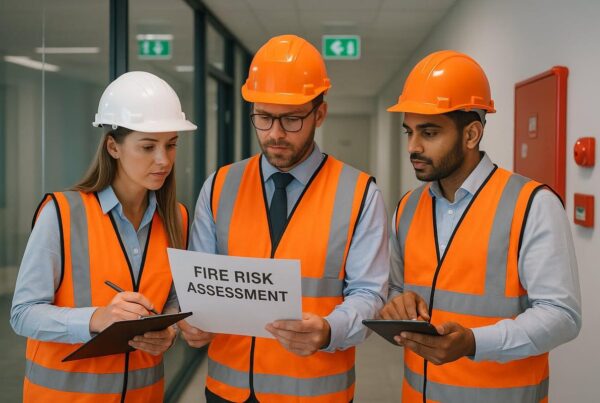
Fire extinguishers should be inspected visually every month, serviced by a competent person at least once every 12 months, and given an extended service every 5 or 10 years, depending on the extinguisher type. These intervals follow BS 5306-3, the British Standard for the maintenance of portable fire extinguishers, and support your duties under the Regulatory Reform (Fire Safety) Order 2005. If you’re unsure what your building needs, start with a fire risk assessment.
In short, there are three layers of care:
- Monthly: a quick visual check by someone on site.
- Annually: a basic service by a qualified engineer.
- Every 5 or 10 years: an extended service, including discharge or pressure testing.
Monthly checks: what the responsible person should do
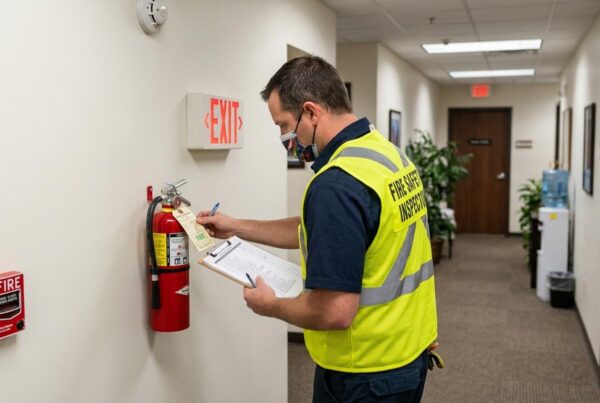
A monthly check is a simple walk-round that takes a few minutes per floor. It does not need an engineer, but it does need to be done and recorded.
Check that each extinguisher:
- Is in its correct location and easy to reach
- Is clearly visible, with signage in place and nothing blocking access
- Has its safety pin and tamper seal intact
- Shows no visible damage, corrosion, leaks or blocked nozzles
- Has a pressure gauge (where fitted) reading in the operating range
- Is clean and has legible instructions and labels
If anything looks wrong, take the extinguisher out of use, arrange a replacement and book an engineer.
Annual servicing: what a competent engineer covers
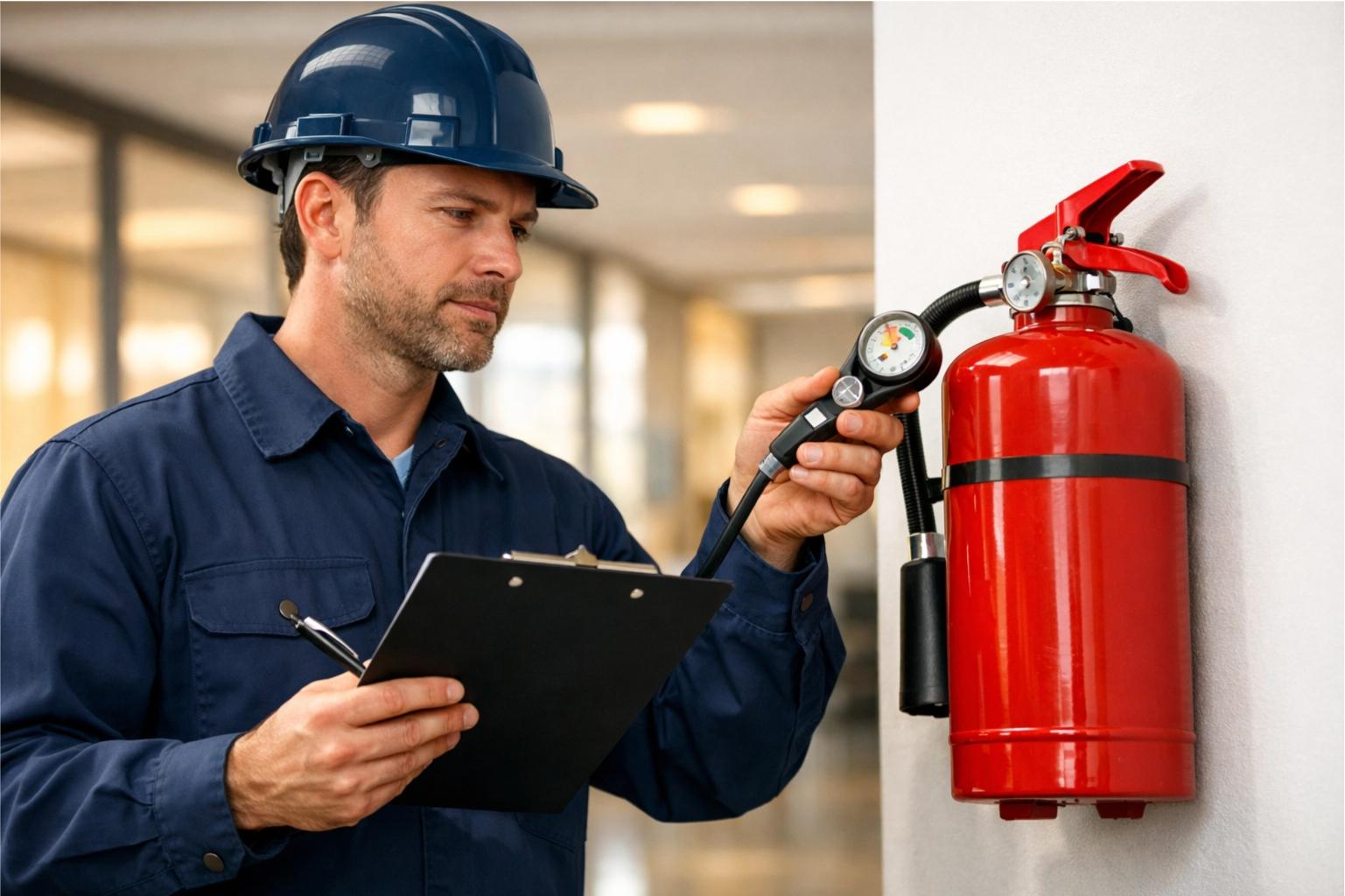
Every year, a competent engineer should carry out a basic service. A competent engineer is someone with the training, equipment and certification to work to BS 5306-3, ideally from a third-party accredited company. You can read more about fire extinguisher servicing and maintenance.
A basic service typically includes:
- Confirming the extinguisher is the right type and in the right place for the risk
- Checking weight, pressure, seals, hoses and operating mechanisms
- Inspecting the casing and valve for damage or corrosion
- Verifying the date of manufacture and previous service history
- Applying a service label showing the date and engineer details
Extended servicing and replacement timelines
Beyond the annual service, extinguishers need a deeper intervention at set intervals:
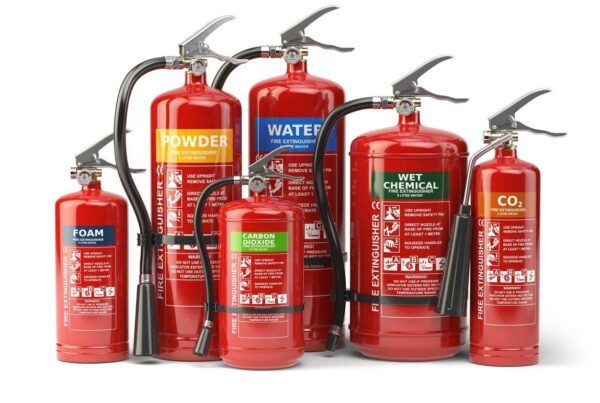
Water, foam and powder extinguishers
These need an extended service every 5 years. The engineer discharges the extinguisher, tests it, then refills and re-pressurises it. Many manufacturers recommend replacement at around 10 years or at the end of the stated service life.
CO₂ extinguishers
These need a pressure test every 10 years to confirm the cylinder is still safe to hold high-pressure gas.
Always check the manufacturer’s guidance for your specific model, as service life can vary.
Fire extinguisher service frequency at a glance
| Check | How often | Who does it | What it involves |
|---|---|---|---|
| Visual inspection | Monthly | Responsible person on site | Location, signage, pin and seal, damage, pressure gauge |
| Basic service | Every 12 months | Competent engineer | Full inspection to BS 5306-3, service label applied |
| Extended service (water, foam, powder) | Every 5 years | Competent engineer | Discharge, test, refill and re-pressurise |
| Pressure test (CO₂) | Every 10 years | Competent engineer | Cylinder pressure test |
| Replacement | End of service life, typically around 10 years | Competent engineer or supplier | Swap for a new, compliant unit |
When should an extinguisher be serviced or replaced early?
Do not wait for the next scheduled service if:
- The extinguisher has been used, even briefly
- The pressure gauge is outside the green zone
- The tamper seal or pin is missing or broken
- There is visible damage, rust or leakage
- The extinguisher has been moved to a harsher environment, such as a kitchen or outdoor area
- The risk in the area has changed and a different extinguisher type is now needed
Who is responsible for fire extinguisher maintenance?
Under the Regulatory Reform (Fire Safety) Order 2005, the “responsible person” (usually the employer, owner or landlord) must make sure fire-fighting equipment is maintained in efficient working order. Our guide to landlord fire safety responsibilities explains who is responsible in more detail. In managed buildings, this duty may be shared between the landlord, managing agent and tenants, so it is worth confirming in writing who owns each task.
Keeping records
Keep a log of every monthly check, annual service, extended service and replacement. Good records show you are meeting your legal duties and make it easy to see when the next action is due. They are also the first thing a fire risk assessor, insurer or enforcing authority will ask for. For other equipment worth tracking alongside extinguishers, see our guides on fire alarm testing and emergency lighting checks.
FAQs
How often do fire extinguishers need to be serviced?
At least once every 12 months by a competent engineer, with a visual check by the responsible person every month.
How often should fire extinguishers be inspected?
Visually inspect them monthly. Many organisations also check high-risk areas more often.
Do fire extinguishers expire?
Yes. Extinguishers have a limited service life, which depends on the type and manufacturer, and are commonly replaced at around 10 years. CO₂ extinguishers need a pressure test every 10 years.
Is servicing fire extinguishers a legal requirement?
Yes. The Regulatory Reform (Fire Safety) Order 2005 requires fire-fighting equipment to be maintained in working order, and BS 5306-3 is the recognised standard for how to do it.
Can I service my own fire extinguishers?
You can carry out the monthly visual checks yourself. Annual and extended services must be done by a competent, trained engineer.
What happens if I miss a service?
Missing a service can leave you non-compliant, may affect your insurance, and means a faulty extinguisher could go unnoticed until an emergency.
Do I need to replace an extinguisher after using it?
Yes. Any extinguisher that has been discharged, even partially, should be recharged or replaced straight away.
Not sure when your fire extinguishers are next due?
Don’t leave fire safety to chance. Book a property compliance check today and make sure every extinguisher in your building is inspected, serviced and compliant.