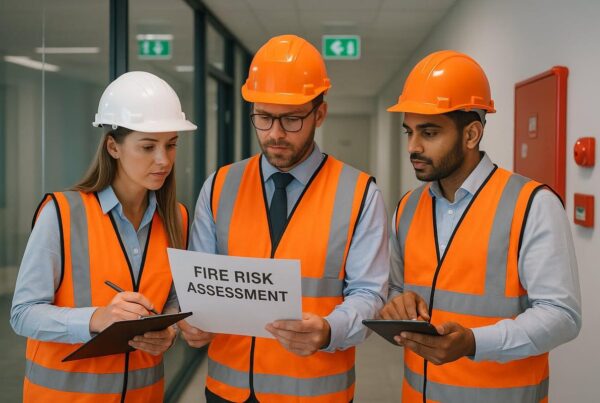
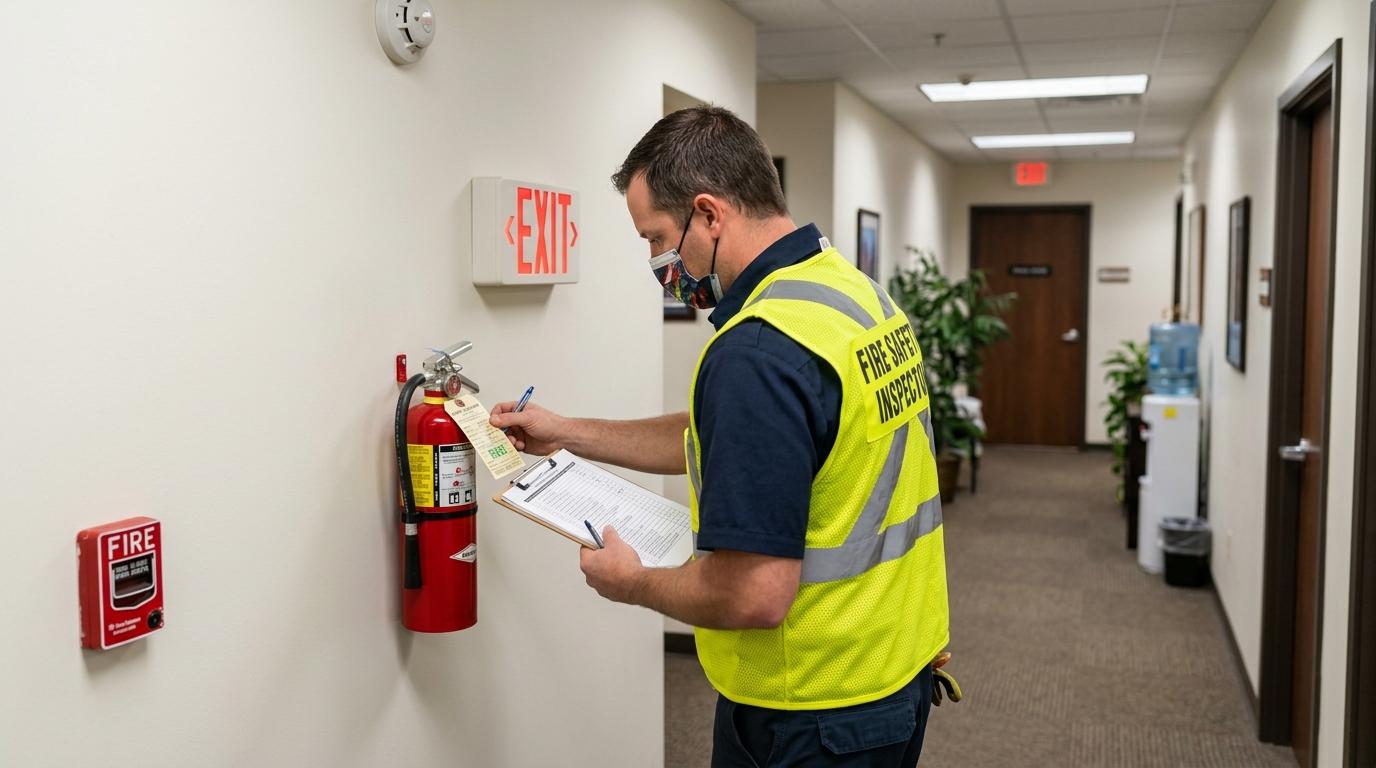

A fire risk assessment (FRA) is a structured inspection of a building’s fire hazards, escape routes and fire safety equipment, followed by a written report with a prioritised action plan. Most residential visits take one to two hours and the report tells you exactly what needs fixing and by when.
Contents:
- The fire risk assessment checklist: what gets inspected
- What happens after: the report, significant findings and action plan
- How long does a fire risk assessment take, and how often do you need one?
- Book a fire risk assessment
- Frequently asked questions
You’ve been told you need a fire risk assessment. Then comes the question nobody answers: what actually happens on the day and what lands on your desk afterwards?
A fire risk assessment (FRA) is a review of how a building could catch fire, who would be in danger and whether the right protections are in place. In England and Wales, it is a legal duty for most non-domestic buildings and for the shared areas of blocks of flats and houses in multiple occupation (HMOs). It is carried out by a competent assessor, meaning someone with the training and experience to judge fire safety properly.
The person who has to arrange it is called the “responsible person“. That is usually the landlord, employer, freeholder or managing agent.
This guide covers the full process, from what an assessor inspects to what happens after the visit. That includes the written report, the significant findings (the issues serious enough to need action) and the action plan, so you know what to expect before anyone turns up.
The Fire Risk Assessment Checklist: What Gets Inspected
On the day, a fire risk assessment checks three things: what could start a fire, how a fire would be spotted and how everyone would get out safely. The assessor walks the building, usually after looking at any paperwork you already have, such as a previous assessment, electrical and gas safety records and your evacuation procedures.
The government’s five-step approach to fire risk assessment is a useful way to picture it. The assessor identifies the fire hazards, identifies who is at risk, evaluates and reduces the risks, records the findings, and sets a point for review.
Here is what typically gets inspected:
| Area | What the assessor looks for | Why it matters |
|---|---|---|
| Fire doors | Doors that close fully, working self-closers, gaps, damaged seals | Slows the spread of fire and smoke |
| Escape routes and exits | Clear corridors and stairs, unlocked exit doors, routes that are not too long | Gives people a safe way out |
| Fire detection and alarms | Smoke and heat detectors, alarm panels, coverage in shared areas | Warns people early |
| Emergency lighting | Lights that work and cover the escape routes | Keeps routes visible in a power cut |
| Signage | Exit signs and fire action notices | Helps people who don’t know the building |
| Fire extinguishers | The right type, in the right place, in date | Allows small fires to be tackled safely |
| Storage and fuel | Rubbish, boxes or furniture stored in hallways, stairwells and bin stores | Removes fuel that helps fire spread |
| Electrical hazards | Overloaded sockets, damaged cabling, signs of faulty equipment | Tackles a common ignition source |
| Paperwork and management | Previous assessments, test records, evacuation plan, who is responsible | Shows safety is actively managed |
The assessor also thinks about people, not just equipment. Anyone sleeping in the building, visitors who don’t know the layout and people who would need help to leave all affect how serious a hazard is.
Fire Risk Assessment for Landlords and HMOs
For landlords, a fire risk assessment checks different things depending on the type of property. The Fire Safety Order covers the shared parts of an HMO or block of flats, but not a single home let to one household.
| Property type | Is an FRA required under the Fire Safety Order? | What the assessor focuses on |
|---|---|---|
| Single home let to one household | Not normally. Housing law still sets fire safety duties, such as working alarms | Not applicable, although many landlords still choose to have one |
| HMO (house in multiple occupation) | Yes, for the communal areas | Shared kitchens, hallways and stairs, the alarm system, fire doors and escape routes, plus how individual rooms affect fire risk |
| Block of flats | Yes, for the communal areas | Stairwells, corridors, bin stores, plant rooms and flat entrance doors |
HMOs are checked more closely because several unrelated households share one building. Shared kitchens are a common place for fires to start, layouts can be confusing for newer tenants and the escape route is often a single staircase.
The assessor will also take account of the whole building, including how bedrooms and their doors affect the escape route. HMO licence conditions set by the local council often add requirements of their own, so a good assessor checks against those too.
Property Checks carries out assessments for HMOs, blocks of flats and commercial premises, so the same visit can be tailored to the building you actually have.
Fire Doors, Escape Routes and Common Areas
Fire doors and escape routes get the closest attention because they decide whether people can get out and whether a fire stays contained. A fire door only works if it is shut when a fire starts, so the assessor tests the details that are easy to overlook:
- Self-closers: the door should swing fully shut and latch every time, without being propped open.
- Gaps: large gaps around the door can let smoke and flames through.
- Seals: intumescent strips and smoke seals should be intact, not painted over or torn.
- Condition: damaged panels, missing hinges and glazing that has been replaced with ordinary glass are all red flags.
In communal areas of flats and HMOs, the assessor also walks the escape route as a resident would. They check that hallways and stairwells are free of bikes, bins, furniture and post, that exit doors open easily without a key and that signs point the right way.
This all comes back to compartmentation, which means dividing a building into fire-resisting sections using walls, floors, ceilings and doors. If a fire starts in one flat or room, compartmentation holds it there for long enough for people to leave and for firefighters to arrive. Gaps around pipes and cables, missing fire stopping and doors that don’t close can all break it.
For multi-occupied residential buildings over 11 metres tall, the law also sets a routine for fire door checks. Communal fire doors must be checked at least every three months and flat entrance doors at least every 12 months on a best-endeavours basis.
What Happens After: The Report, Significant Findings and Action Plan
A good assessor doesn’t just leave you with a ticked checklist. They produce a written report that records what was inspected, what was found and what you need to do about it.
Findings are grouped by urgency, so you can see at a glance what needs fixing first. Property Checks reports include photo evidence and a prioritised action plan, delivered digitally so you can forward it to a managing agent, contractor or insurer.
Keep the report on file. Fire and rescue authorities, councils and insurers can all ask to see it, and the responsible person is the one expected to act on it. If you’re not sure whether that is you, see our guide to who is responsible for a fire risk assessment.
The table below shows how priorities typically work. The exact labels and timescales vary between assessors and your report will state its own.
| Priority | What it means | Example |
|---|---|---|
| High | An immediate risk to life | Blocked escape route, alarm not working |
| Medium | A real gap that needs fixing soon | Fire door that won’t close properly |
| Low | A minor improvement or tidy-up | Worn signage, missing test record |
What Are Significant Findings in a Fire Risk Assessment?
Significant findings are issues serious enough to need action because they put people at real risk if a fire starts. They are different from minor observations, which are small improvements worth making but not urgent. Not every note in your report is a significant finding.
Common examples include:
- A blocked escape route, such as a stairwell used to store bikes or boxes.
- A faulty fire door, such as one with a broken self-closer or a large gap around the frame.
- A fire alarm or emergency lighting that doesn’t work, so nobody would be warned or able to see the way out.
A significant finding isn’t a failure grade. Most can be fixed with maintenance, repairs or a small upgrade and the report tells you how.
What’s Included in a Fire Risk Assessment Action Plan?
The action plan is the part of the report you work from. It is a list of what needs doing, in priority order and each significant finding gets a recommended fix and a realistic timescale.
A useful action plan includes:
- A clear description of the issue and where it is.
- Its priority level.
- The recommended remedy.
- A realistic deadline for completing it.
This is the document a landlord or building manager needs to act on to stay compliant. Keep a record as each item is done, such as an invoice or a photo of the repaired door. If serious risks are ignored, the fire authority can issue enforcement notices, fines or restrictions on how the building is used.
How Long Does a Fire Risk Assessment Take and How Often Do You Need One?
Most residential fire risk assessments take one to two hours on site. Larger or more complex buildings take longer and you can expect the written report and action plan shortly after the visit.
The table is a rough guide, because the real time depends on the size, layout and condition of the building.
| Property type | Typical time on site |
|---|---|
| Standard residential building or communal area | 1 to 2 hours |
| HMO with several units, or a block with many floors | 2 to 3 hours or more |
| Commercial premises (offices, shops, clinics) | A few hours, longer for large sites |
| Care home or other special premises | Often longer, as layouts are more complex and residents’ needs must be considered |
How often you need one
There is no fixed legal interval, but the law says the assessment must be reviewed regularly. Reviewing it once a year is standard practice and some higher-risk buildings need it more often.
An earlier reassessment is needed whenever something changes, such as:
- Renovation or building work, including changes to layout
- A change of use or a change in who occupies the building
- A previous significant finding that has been fixed, so the fix can be confirmed
- A fire, near miss or any reason to think the assessment is out of date
For blocks of flats, Local Government Association guidance goes further. It suggests higher-risk or taller blocks are reviewed every year and fully redone every three years.
Practical reassurance
Booking doesn’t have to hold anything up. Property Checks offers same-day appointments in London and Buckinghamshire, subject to availability and delivers the report and action plan digitally so you can start work on any findings straight away.
Book a Fire Risk Assessment
Now that you know what gets inspected and what you’ll receive afterwards, the next step is simple. You can book a fire risk assessment with Property Checks for an HMO, block of flats, commercial unit or specialist premises.
Here is what you can expect:
- Assessors who are IFSM-accredited, insured and experienced with residential and commercial buildings
- Fixed pricing with no hidden charges
- A clear report with photo evidence, risk grading and a prioritised action plan
- Follow-up help with fire doors, extinguishers, alarms and emergency lighting if the report finds issues
To talk it through first, call 0208 432 9484 (Monday to Friday, 8 am to 6 pm).
Frequently Asked Questions
How Long Does a Fire Risk Assessment Take?
Most residential fire risk assessments take one to two hours, depending on the size and layout of the property. Larger commercial or multi-occupancy buildings take longer.
How Often Should a Fire Risk Assessment Be Carried Out?
There is no fixed legal interval, but annual reviews are standard practice. The assessment should be reviewed sooner after any renovation, change of use or previous significant finding.
What Are Significant Findings in a Fire Risk Assessment?
Significant findings are issues serious enough to pose a real fire risk, such as a blocked escape route or a faulty fire door. They must be addressed within the timescale set in the action plan.
What Should Be Included in a Fire Risk Assessment Action Plan?
A fire risk assessment action plan should include a clear description of each issue, its priority level, a recommended remedy and a realistic deadline for completion.