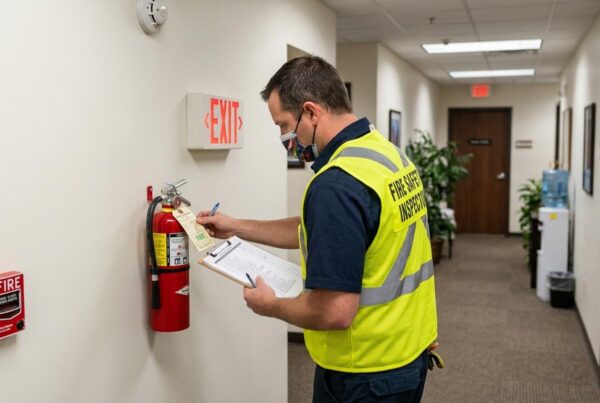
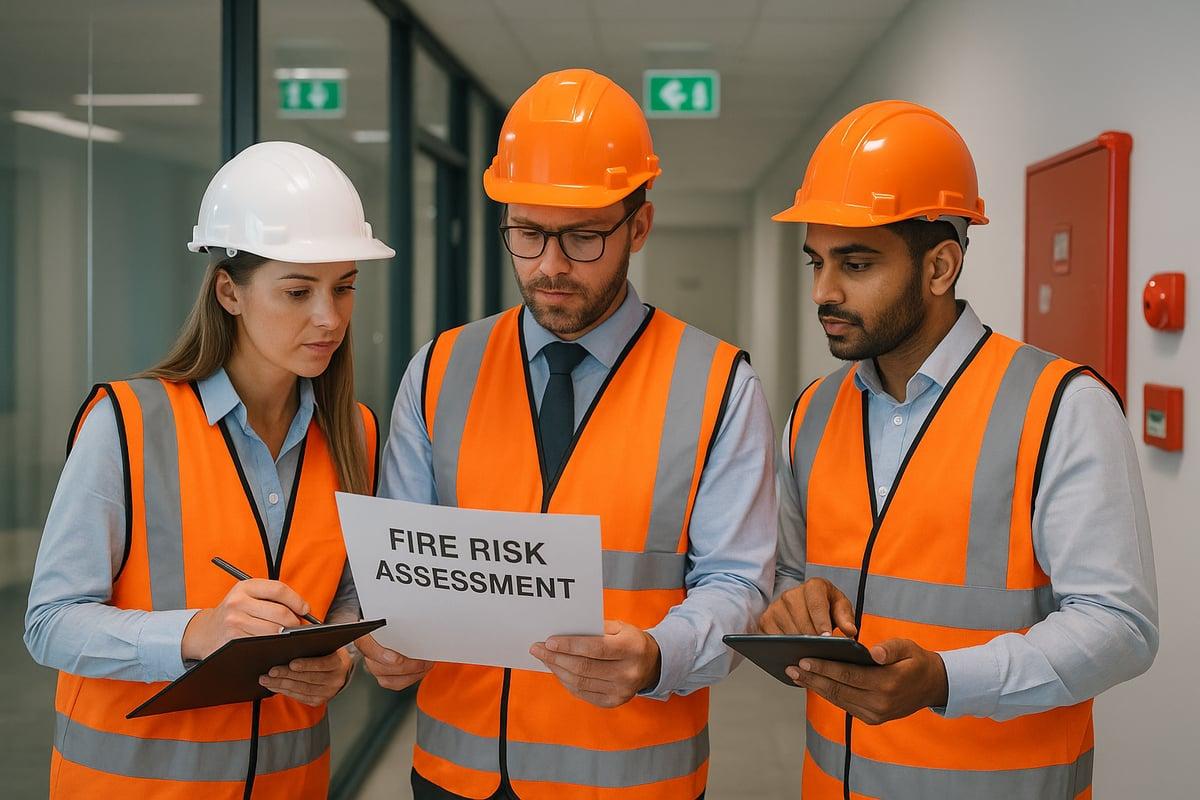

Fire risk assessments in housing come in four types, depending on whether the assessor inspects only the communal areas or also a sample of flats, and whether they open up the building. Most blocks of flats need a Type 1 or Type 3, both of which Property Checks carries out.
Content:
- What Are the 4 Types of Fire Risk Assessment?
- Type 1 and Type 3 Fire Risk Assessments: The Non-Destructive Options
- Type 2 and Type 4 Fire Risk Assessments: The Destructive Options
- Which Type of Fire Risk Assessment Does Your Building Need?
- How Much Does a Fire Risk Assessment Cost by Type?
- Book the Right Fire Risk Assessment for Your Building
- Frequently Asked Questions
- What Is the Difference Between a Type 1 and a Type 3 Fire Risk Assessment?
- What Is an Intrusive Fire Risk Assessment?
- How Do I Know Which Type of Fire Risk Assessment I Need?
- Do All Blocks of Flats Need a Type 4 Fire Risk Assessment?
- Can a Fire Risk Assessment Move From Type 1 to Type 3 or Type 4?
- Does Property Checks Carry Out Type 2 or Type 4 Assessments?
- How Much Does a Type 1 or Type 3 Fire Risk Assessment Cost?
If an assessor or an invoice has told you that your block needs a “Type 3” fire risk assessment and nobody has explained what that means, you are not alone. The numbering sounds like a ranking of how dangerous your building is. It isn’t.
This guide explains all four types of fire risk assessment, what each involves and how to determine which one your building needs. It is written for housing association and social housing compliance teams, managing agents, freeholders and landlords responsible for blocks of flats.
Property Checks carries out Type 1 and Type 3 assessments. We also explain Type 2 and Type 4 below, so you know what they involve and when an assessor might recommend one.
What Are the 4 Types of Fire Risk Assessment?
The four types of fire risk assessment are Type 1, Type 2, Type 3 and Type 4. They come from BS 9792:2025, the British Standards Institution (BSI) code of practice for fire risk assessments in housing. It replaced PAS 79-2, the older name you may still see in reports and quotes.
The types describe how far an assessment goes, not how serious your building’s fire risk is. A Type 1 does not mean a low-risk building and a Type 4 does not mean a dangerous one. Two things change from one type to the next:
- Scope: whether the assessor covers the communal areas only or the communal areas plus a sample of individual flats.
- Method: whether the inspection is non-destructive (visual only) or destructive (the assessor opens up parts of the building).
| Type | Scope | Method | Does Property Checks carry it out? |
|---|---|---|---|
| Type 1 | Common parts only | Non-destructive | Yes |
| Type 2 | Common parts only | Destructive | No |
| Type 3 | Common parts and a sample of flats | Non-destructive | Yes |
| Type 4 | Common parts and flats | Destructive | No |
This classification applies to housing, mainly blocks of flats. Other buildings, such as offices, shops and care homes, are assessed under different guidance.
Type 1 and Type 3 Fire Risk Assessments: The Non-Destructive Options
Type 1 and Type 3 are visual inspections. Neither involves opening up walls, ceilings or any other part of the building, so there is nothing to make good afterwards.
Type 1 Fire Risk Assessment: Common Parts Only
A Type 1 fire risk assessment is a non-destructive inspection of a building’s communal areas only. The assessor does not go into individual flats.
Common parts include corridors, stairwells, lobbies, entrance areas, bin stores and shared plant rooms. The assessor checks things such as:
- The condition of fire doors in communal areas, including gaps, closers and seals
- Whether escape routes are clear and easy to follow
- Fire detection and alarm systems
- Emergency lighting and signage
- Any visible gaps in fire-stopping
- How fire safety is managed, including records and testing
Under the Regulatory Reform (Fire Safety) Order 2005, the responsible person for a block of flats must assess the fire risk in the communal areas. A Type 1 is the usual way to do that, which makes it the most common starting point for a block of flats.
Type 3 Fire Risk Assessment: Common Parts and a Sample of Flats
A Type 3 fire risk assessment covers everything in a Type 1, plus access to a sample of individual flats. It is still non-destructive: the assessor looks, but does not open up walls, ceilings or floors.
A sample means the assessor does not inspect every flat. They look at a representative selection and you will need to arrange access with the residents. From inside those flats, the assessor can check:
- Flat entrance doors
- Smoke and heat detection
- Escape routes within the flat
- Visible gaps where pipes or cables pass through walls and ceilings
A Type 3 suits buildings where there is reason to think risks sit inside the flats as well as in the shared areas. Examples include concerns about flat entrance doors, or a wish for a fuller picture than the communal areas alone can give.
Type 1 vs Type 3 in one line: a Type 1 covers the communal areas only, while a Type 3 covers the communal areas and a sample of flats. Both are non-destructive.
Type 2 and Type 4 Fire Risk Assessments: The Destructive Options
Type 2 and Type 4 are destructive fire risk assessments, also called intrusive assessments. Property Checks does not carry them out, but it helps to know what they involve because an assessor may recommend one after a Type 1 or Type 3.
Why are they recommended?
A visual inspection cannot show what is behind a wall or above a ceiling. If an assessor cannot tell whether fire compartmentation is intact, they may recommend opening up the structure. Fire compartmentation is the fire-resisting walls, floors and seals that stop fire and smoke from spreading through a building.
What do “destructive” and “intrusive” mean in practice?
The assessor physically opens up parts of the building, for example by lifting floorboards, opening up voids and ceilings or cutting small inspection holes in walls. The building is then repaired. Because of the opening up and repair work, destructive assessments take longer and cost more than a visual inspection. In a building constructed before 2000, an asbestos survey is usually needed before any opening up begins.
Type 2 Fire Risk Assessment: Destructive, Common Parts Only
A Type 2 fire risk assessment has the same scope as a Type 1, communal areas only but the assessor opens up parts of the building in those shared areas. This lets them check hidden features such as fire-stopping above ceilings or inside voids.
What Is a Type 4 Fire Risk Assessment?
A Type 4 fire risk assessment is the most thorough type: a destructive inspection of the communal areas and the flats. You may see Type 2 and Type 4 referred to as an “intrusive fire risk assessment” on quotes and reports.
Most blocks of flats do not need a Type 4. It is reserved for buildings with a specific, unresolved concern, such as doubts about fire compartmentation that a visual inspection cannot settle.
Although we do not carry out Type 2 or Type 4 assessments, please contact our team to discuss your requirements and get advice on the appropriate next steps.
Which Type of Fire Risk Assessment Does Your Building Need?
Most blocks of flats start with a Type 1. Move to a Type 3 if there is a reason to look inside the flats and expect a Type 2 or Type 4 only if an earlier assessment could not rule out a hidden problem.
Three things usually decide it:
- Building type and age. Older blocks of flats are more likely to have hidden defects, such as gaps in fire compartmentation, so they are more likely to need a destructive follow-up.
- What a previous assessment found. If an earlier assessment flagged a concern it could not resolve by looking, ask the assessor what that concern was before agreeing to a more detailed type.
- Specific triggers. Failed fire doors, unclear compartmentation or concerns about conditions inside flats all point towards a more detailed assessment. A fire door inspection can help pin down door problems.
| Your situation | Likely type | Can Property Checks help? |
|---|---|---|
| Routine assessment of a block’s communal areas | Type 1 | Yes |
| Concerns about conditions inside individual flats | Type 3 | Yes |
| A previous assessment could not confirm compartmentation in the communal areas | Type 2 | No, contact us for advice |
| Compartmentation concerns across the communal areas and the flats | Type 4 | No, contact us for advice |
| You have been told a type but not why | Speak to the assessor first | Yes, we can talk it through |
For more on how assessments work for residential blocks, read our guide to fire risk assessment for flats. For a longer walk-through of every type, see our complete guide to the different types of fire risk assessments.
How Much Does a Fire Risk Assessment Cost by Type?
The cost of a fire risk assessment rises with the type, because each step up adds time, access or physical work. A Type 1 is the most straightforward. A Type 3 takes longer because the assessor also needs access to a sample of flats. Destructive assessments, Type 2 and Type 4, cost more again because of the opening up and the repairs afterwards.
The size and layout of the building also affect the price. Property Checks gives a fixed, no-obligation price for Type 1 and Type 3 assessments once we have confirmed your property, so you know the cost before you book. There are no hidden charges.
For background on how fire risk assessments work, see our guide to fire risk assessments for businesses and property owners.
Book the Right Fire Risk Assessment for Your Building
Choosing the wrong type costs you either way. Too little and a concern goes unresolved. Too much and you pay for work you did not need. Tell us about your building and we will confirm whether a Type 1 or Type 3 is the right fit, or whether you need advice on other options.
Although we do not carry out Type 2 or Type 4 assessments, please contact our team to discuss your requirements and get advice on the appropriate next steps.
You can:
- Call us on 0208 432 9484, Monday to Friday, 8 am to 6 pm
- Book a fire risk assessment online
- Request a fixed-price quote
We cover London and Buckinghamshire.
Frequently Asked Questions
What Is the Difference Between a Type 1 and a Type 3 Fire Risk Assessment?
A Type 1 covers the communal areas only, while a Type 3 covers the communal areas and a sample of individual flats. Both are non-destructive, so neither involves opening up walls, ceilings or floors.
What Is an Intrusive Fire Risk Assessment?
An intrusive fire risk assessment, also called a destructive assessment, is a Type 2 or Type 4. The assessor physically opens up parts of the building, such as floor voids or ceilings, to check fire compartmentation that cannot be verified visually. Property Checks does not carry these out, but you can contact our team for advice on next steps.
How Do I Know Which Type of Fire Risk Assessment I Need?
Most buildings start with a Type 1. A Type 3 suits buildings where conditions inside the flats may be a concern. You will usually only need a Type 2 or Type 4 if an earlier assessment flagged a concern that could not be confirmed without opening up the structure.
Do All Blocks of Flats Need a Type 4 Fire Risk Assessment?
No. A Type 4 is reserved for buildings with a specific reason to investigate further, such as unresolved compartmentation concerns. It is not a default requirement for every block.
Can a Fire Risk Assessment Move From Type 1 to Type 3 or Type 4?
Yes. If a Type 1 cannot rule out a fire safety concern, the assessor may recommend a Type 3 to look inside flats or a Type 2 or Type 4 to look behind walls and ceilings.
Does Property Checks Carry Out Type 2 or Type 4 Assessments?
No. Although we do not carry out Type 2 or Type 4 assessments, please contact our team to discuss your requirements and get advice on the appropriate next steps.
How Much Does a Type 1 or Type 3 Fire Risk Assessment Cost?
Property Checks gives a fixed, no-obligation price for both once the scope is confirmed. See the cost section above for what affects the price.